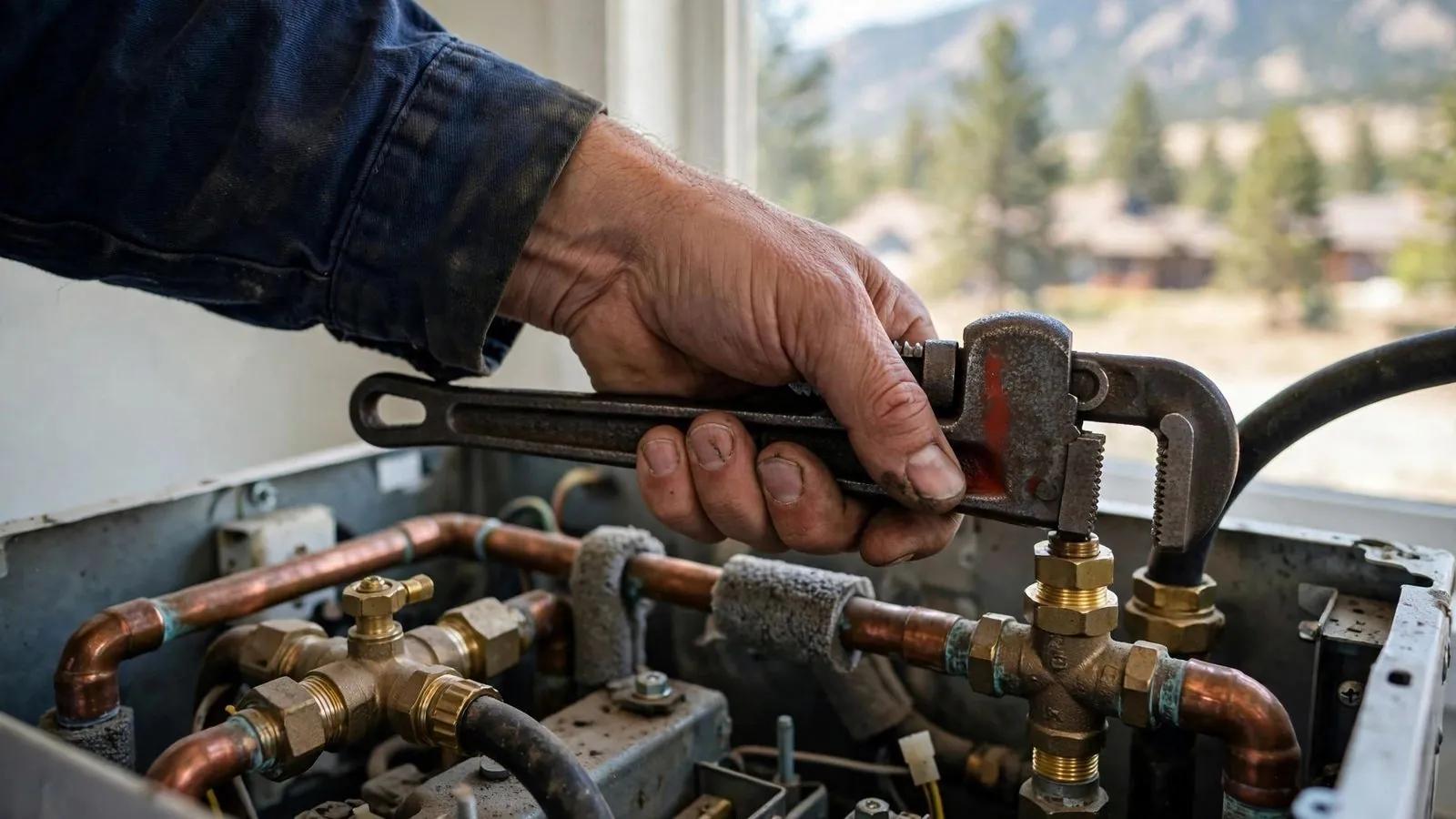
A boiler diverter valve sends hot water to one place or another. On a combination boiler it switches heat between your radiators and your hot taps. On an older one pipe hot water system, a diverter tee pushes part of the flow into each radiator. When either fails, the symptoms are heat but no hot water, hot water but no heat, or uneven radiators.
If your boiler is working in Braintree, MA but one half of the job is missing, the diverter is a suspect. The sections below help you tell which type you have, what a repair usually involves, and which checks are safe before you call.
Two different parts share the name
Homeowners call both of these a diverter valve, but they fail in different ways and are fixed in different ways.
Three way diverter valve (combi boiler)
- Sits inside or beside a combination boiler.
- A motor head moves a valve to send heat to radiators or to the hot tap.
- Failure shows as heat with no hot water, or the reverse.
- Often repaired by replacing the cartridge or motor head, not the whole boiler.
Diverter tee (one pipe hydronic loop)
- A fixed fitting on the main loop with no moving parts.
- Uses flow direction to pull some water into each radiator.
- Failure shows as one radiator cold while others run hot.
- Often a placement, air or flow problem, not a broken part.
Signs the diverter is the problem
Look for a pattern before you assume the valve. Several other parts can mimic it.
Heat but no hot water.
On a combi boiler, the valve may be stuck in the heating position so water never reaches the hot tap.
Hot water but no heat.
The valve is stuck on the hot water side, or the motor head is not moving it back after a tap is closed.
Both at once, weakly.
A worn seal or a half-open valve can send heat to both circuits and leave neither at full strength.
Humming, banging or clicking.
A motor head that is trying to turn a seized valve can click or hum without moving it.
Radiator cold at one end of a loop.
On a one pipe system, a diverter tee installed backwards or choked with sludge starves the radiators beyond it.
Water around the valve.
A weeping seal on the valve body can drip onto the boiler. It needs prompt repair before it reaches electrical parts.
A pump that has failed, trapped air and sludge can look the same, so a plumber tests the pump and flow before replacing parts.
What you can check, and what to leave alone
Safe checks are limited to what is visible and does not involve opening sealed parts.
| Check | Safe for a homeowner? | Why. |
|---|---|---|
| Boiler pressure gauge. | Yes. | Low pressure points to a leak or a need for a refill by the maker's method. |
| Radiator thermostats and room thermostat setting. | Yes. | A wrong setting can mimic a failed valve. |
| Bleeding a radiator with a key. | Yes. | Releases trapped air, but catch the drip and close it as soon as water appears. |
| Listening for the valve motor click. | Yes. | Silence when you open a tap suggests the motor head or wiring. |
| Removing the valve cartridge. | No. | The system must be drained or isolated and pressure released first. |
| Anything on the burner, flue or gas valve. | No. | Combustion parts are a separate trade and a safety matter. |
If you smell gas, leave the building and call your gas utility's emergency line or 911. If you smell oil smoke or hear a carbon monoxide alarm, do the same.
No heat tonight?
Call (617) 752-0573 and tell the dispatcher your boiler brand and what the radiators and taps are doing. If you smell gas, leave first and call your gas utility or 911.
Braintree: an older housing stock and a long heating season
Census data puts the median Braintree home at a 1957 build, and about 74.7 percent of homes were built before 1980. Houses of that age are where older boilers and older piping layouts are most likely to turn up, so diverter tees and aging valves are worth asking about. Ask your plumber to identify the boiler type and the piping layout first, so the repair matches the system you actually have.
The Blue Hill station in Milton, the nearest NOAA normals station, records about 120.9 days a year with lows at or below freezing. That is a long stretch when a failed diverter leaves a house cold or without hot water. The station sits on a hilltop, so Braintree numbers will differ, but the point holds: book repairs in early fall, not in the first cold snap.
How a plumber repairs a diverter valve
Confirm which valve it is.
The plumber identifies the boiler type, finds the valve and tests whether the motor head moves it before blaming the valve body.
Isolate and relieve pressure.
Isolation valves are closed and pressure is bled off. On sealed systems, part of the water is drained to avoid a spill.
Replace the failed part.
A worn cartridge, seal or motor head is swapped. If the valve body is cracked or corroded, the whole valve is replaced.
Refill, bleed and test.
The system is refilled to the correct pressure, air is bled out, and both heating and hot water are run to prove the valve switches cleanly.
Repair or replace the boiler
A diverter is a modest part on a sound boiler, and replacing it is usually far cheaper than a new boiler. The calculation changes if the heat exchanger is leaking, the boiler is very old, or parts are no longer made. Ask the plumber for the boiler's age, its repair history and what else is near the end of life.
If the answer points toward replacement, you may be choosing between a combi unit and a boiler with a separate hot water tank. Our water heater installation page explains how an indirect tank works with a boiler. Our boiler repair page covers the plumbing-side work we handle, including piping, valves and pressure relief. Burner-side oil work is a separate license, so ask who handles each part.
Where we dispatch
The same line serves nearby towns such as Quincy and Randolph. Tell the dispatcher your boiler brand, the model if you can read the label, and the symptom, so the right parts ride along.
Boiler diverter questions from Braintree homeowners
Combination boilers that heat both radiators and taps have one. A heating-only boiler with a separate hot water tank usually does not. Look for the model label or ask a plumber to identify it.
Sometimes. A stuck cartridge can be loosened or cleaned, but the system must be isolated first. If the valve body is worn, replacement is the longer-term fix.
It can be if you have no heat in cold weather or water leaking onto the boiler. A stuck valve that leaves you with heat but only weak hot water can often wait for a scheduled visit.
It sits in the main loop and uses its shape to pull part of the flow into a radiator branch. If it was put in backwards or sludge has built up, radiators farther down the loop run cold.
No. Draining without isolating and relieving pressure can scald you, flood the floor and introduce air. Leave valve work to a licensed plumber.
Not necessarily. Census data shows most Braintree homes predate 1980, but the piping layout depends on each house. A plumber can identify it on site.