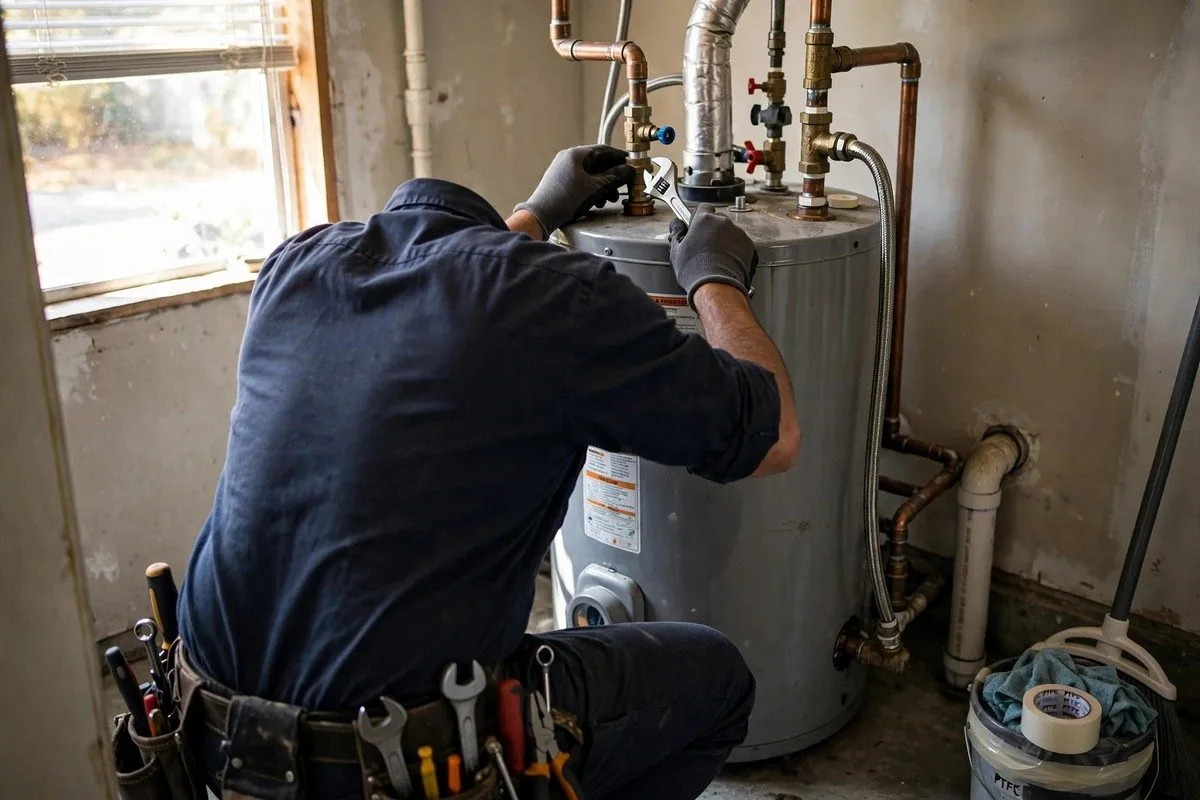
A water heater in trouble rarely waits for a convenient hour, so our 24/7 dispatch line covers the cold shower, the wet floor, and the smell of gas alike. If you see water, close the cold supply valve on top of the tank. If you smell gas, leave the building and call your gas utility's emergency line or 911 before you call us.
Water heater repair in Braintree, MA means diagnosing why a tank, gas, electric, or hybrid, has stopped heating, started leaking, or begun to make noise, then replacing the failed part when the tank is still worth keeping. The sections below show how each symptom is traced and where repair stops making sense.
While you wait for the plumber
These steps limit damage and give the technician a head start. None of them requires tools.
- Close the cold water valve on the pipe above the tank.
- Switch off the heater's breaker or turn the gas control to off.
- Keep the T&P discharge pipe open and do not cap it.
- Dry the tank and look for the first drop to form.
- Note the model, age, and fuel from the data plate.
- Clear stored items away from the heater and floor drain.
Four symptoms and what each one usually points to
The complaint tells us where to look first. Here is how we read the four most common ones.
Water on the floor.
A leak at the cold inlet, hot outlet, drain valve, or T&P valve is a part problem. A leak from the shell itself is not. We dry everything, then watch which spot wets first before touching a wrench.
Not enough hot water.
A broken dip tube lets cold water short circuit to the outlet. On electric tanks a dead lower element leaves only the upper half hot. On gas tanks a dirty burner or a weak flame cuts recovery.
No heat at all.
Electric tanks lose heat to a tripped high limit, a bad thermostat, or both elements. Gas tanks lose it to a pilot that will not stay lit, a failing thermocouple, or a faulty gas control valve.
Popping, rumbling, or hissing.
Sediment on the bottom traps steam bubbles under the burner or element, which makes the popping sound. Hissing can mean water dripping on a hot element, so it is worth checking for a small leak.
Rusty or smelly hot water.
Brown water only on the hot side points to the tank interior. A rotten egg smell often comes from a reaction at the anode rod, which a plumber can address by replacing the rod type.
Tripping breaker.
A heater that trips its breaker repeatedly may have a shorted element or a ground fault. Do not keep resetting it. Leave it off and call.
If two symptoms show up together, say so on the phone. A leak and no heat at once usually means a tank that has already failed.
Heater down and the family needs a shower?
Call (617) 752-0573 and describe the symptom. We book same-day visits when available and take after-hours calls.
Gas, electric, and hybrid: what fails on each
The three kinds of tank wear out in different places. Knowing which you own narrows the first checks.
| Type | Parts that fail most | First checks we make. |
|---|---|---|
| Gas, atmospheric vent. | Thermocouple, pilot assembly, gas control valve, burner orifices. | Pilot flame color, draft at the hood, gas pressure, soot or rust at the base. |
| Gas, power vent or direct vent. | Blower motor, pressure switch, igniter, condensate trap on condensing models. | Error code on the control board, vent blockage, igniter resistance. |
| Electric tank. | Upper or lower element, thermostats, high limit reset. | Voltage at the terminals, element resistance, thermostat continuity. |
| Hybrid heat pump. | Condensate drain, air filter, fan, compressor controls, backup elements. | Display faults, filter condition, drain flow, space around the unit. |
Hybrid units are still electric tanks underneath, so a failed backup element behaves like any electric tank. The heat pump top adds a filter and condensate drain that homeowners often forget until it clogs.
The parts we replace, and how we know which one failed
On an electric heater, the first test is power. With the breaker off we check each element's resistance with a multimeter. An open element reads infinite, a shorted one reads near zero, and a grounded one leaks current into the shell. Elements and thermostats are inexpensive parts, so a tank in decent shape is worth fixing.
On a gas heater, we light the pilot and watch the flame. A weak yellow flame suggests a dirty orifice or poor air, and a pilot that dies when you release the knob points to a worn thermocouple. Newer units use an electronic igniter, and a cracked igniter or failed gas control valve shows up in the error pattern.
The T&P valve is a safety device that opens at high temperature or pressure. If it drips constantly, the cause may be thermal expansion on a closed system, which an expansion tank solves, or a worn valve. Replacing the valve alone without checking for expansion pressure only buys you a few months.
How a repair visit works from the first look
The order matters because it keeps us from replacing parts that were never broken.
Safe the heater.
We confirm the fuel and water are off, check for gas around a gas heater with a combustible gas detector, and note the tank age from the data plate.
Reproduce the fault.
We restore power or gas under supervision and watch the symptom happen. Intermittent faults often hide behind loose wiring or a tired thermostat.
Test the suspect parts.
Meter readings on elements and thermostats, flame and draft checks on gas units, and a pressure gauge on the water line show what has actually failed.
Quote before the wrench.
You hear the price for the part and labor, and whether we recommend repair or replacement, before any part is ordered or installed.
When to stop repairing and replace
Repair is the right call more often than people expect, but not always. This is how we weigh it.
Repair usually makes sense when.
- The tank body is dry and the data plate shows a younger unit.
- A single part has failed, such as an element, thermostat, or thermocouple.
- The heater is the right size and fuel for your household.
- A T&P valve is dripping only because of expansion pressure.
Replacement usually makes sense when.
- Water is seeping from the bottom of the shell or the jacket.
- The tank is old and has needed repeated repairs.
- The anode rod is gone and the tank is already rusting.
- The repair would cost a large share of a new heater.
- You are outgrowing the capacity or want a different fuel.
Flushing, anode rods, and the water in Braintree
A flush clears sediment from the tank floor, and an anode rod inspection tells you how much protection is left. Braintree's own Water and Sewer Department reports hardness of 47.8 mg/L in its 2024 report, about 2.8 grains per gallon by our approximate conversion. That is soft water, so scale forms more slowly than in hard water regions, but sediment and rod wear still happen, and a yearly look is cheap protection.
Soft municipal water also means you do not need a softener to save the heater. If you already own a softener, ask the plumber to check the anode rod, because softened water can use up some rods faster. The pH in the same report is 7.75, which is in the usual range, so it is nothing unusual for a tank.
Heaters in garages and unheated corners
Plenty of New England homes keep the water heater in a garage or an unheated utility room. The nearest federal weather record, from the Blue Hill station in Milton, shows about 121 days a year with lows at or below freezing. A tank in an unheated space needs insulated supply lines and a safe place for the drain and discharge, and its pipes can crack before the tank does.
If your heater sits in a cold spot, mention it when you call. A garage heater also needs protection from vehicle impact and stored fuel, which a plumber will check during a repair visit.
What decides the repair price
Repairs run from a quick part swap to a long diagnosis, so quoting over the phone would be a guess. Call (617) 752-0573 and we give a clear price before work starts.
Repairs from normal wear are rarely covered by a homeowner's policy. If the tank burst suddenly and damaged finished space, that may be handled as water damage, so photograph it and call your insurer before cleanup begins.
Before you call about a bad water heater
Yes. The dispatch line answers overnight and on weekends, and same-day appointments are available when the schedule allows. Shut the cold valve on top of the tank and switch off the power or gas first, and tell us the fuel type and what you see.
Top leaks usually come from the cold inlet, hot outlet, or an anode rod fitting, all of which can be repaired. Water at the bottom is different and usually means the shell has failed. See water heater replacement if the shell is the source.
A gas pilot may have gone out, or an electric high limit may have tripped. Do not relight a pilot if you smell gas. Leave the house and call your gas utility's emergency line or 911 first.
Sediment collects in any tank. The town's report shows soft water, so scale is slower than in hard water regions, but ask your water utility for the current report. A yearly flush keeps the burner or element from working harder than it needs to.
Tankless units fail differently, with flow sensors, igniters, and scale in the heat exchanger. We cover that on our tankless water heater page, including flushing.
It depends on where the water comes from. A weeping fitting is worth fixing, but a weeping shell is not. If you are not sure, our leak detection team can confirm the source, and we also serve nearby Weymouth.