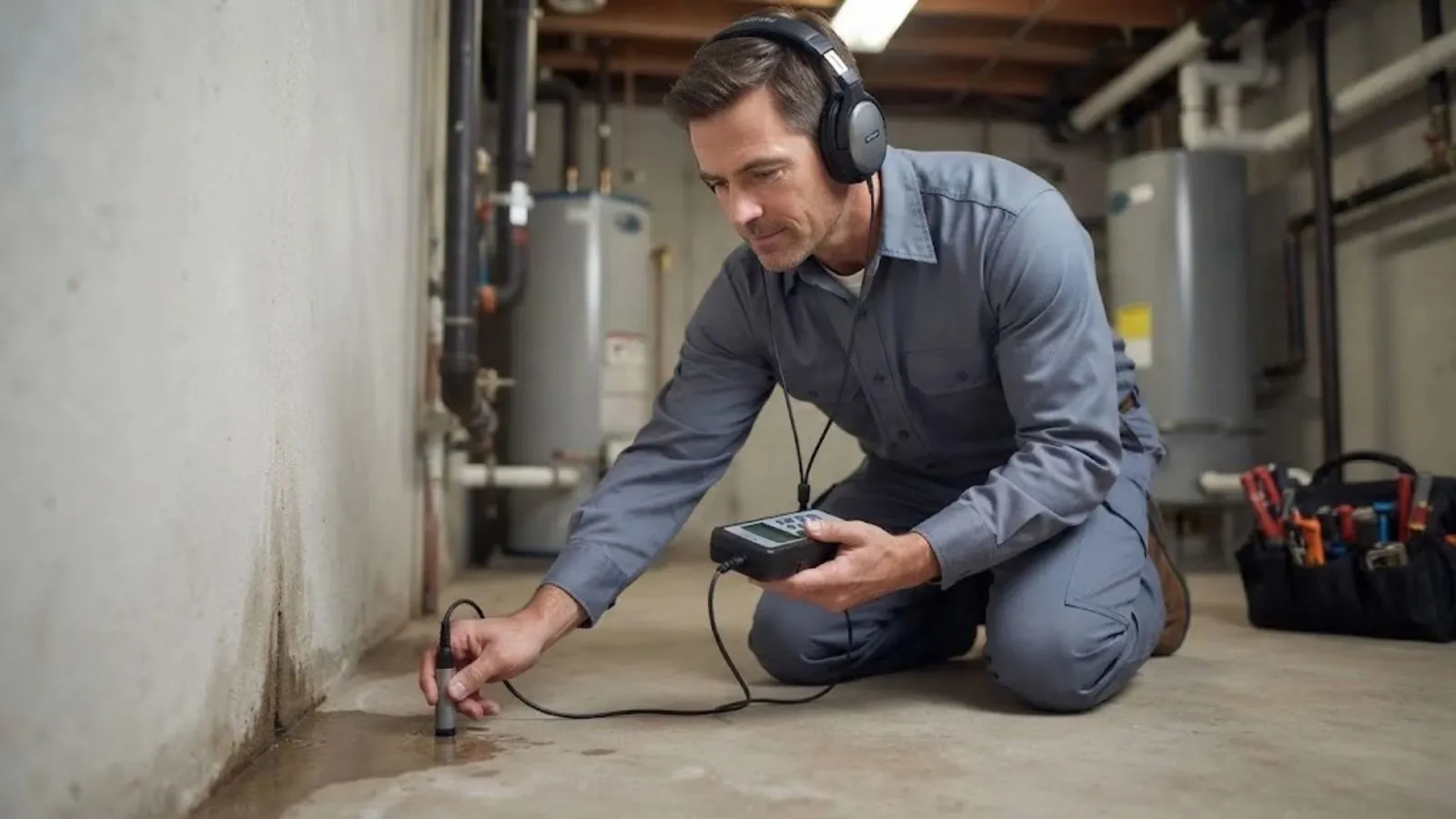
If water is spreading, the meter will not stop or a ceiling is dripping, call our 24/7 line now and shut the main valve while you wait. Leak detection in Braintree, MA means locating a hidden leak by testing the pipes instead of cutting into drywall or concrete and hoping. Most people call because of a symptom, not a theory, so this page is organized around the symptoms.
The short version of how it works: we first decide whether the leak is on the supply side (pressurized water lines) or the drain side, then narrow it with pressure tests, listening gear, heat imaging, tracer gas or a camera. Each method answers a different question. After-hours and weekend calls are handled the same way as daytime ones, and same-day appointments are offered when the schedule allows.
Water is pouring or soaking a ceiling right now
Stop the water first and diagnose second. Find the valve where the water pipe first enters the building, usually in the basement or utility area near the meter, and turn it fully closed. Town rules also point to that entry valve as the place to shut off an in-building leak.
- Close the main valve, then open one low faucet to drain the lines.
- Switch off power to any room with water near outlets, lights or a ceiling fixture.
- Put a bucket under a ceiling bulge. A small hole lets it drain in a controlled way instead of letting it collapse.
- Move furniture, rugs and electronics out of the wet area, then call the 24/7 line.
Which detection method answers which question
No single tool finds every leak. A good visit starts with the cheapest test that rules things in or out, then moves to finer tools only as needed.
| Method | What it tells you | Where it works best | Where it falls short. |
|---|---|---|---|
| Pressure test. | Whether a pipe section holds pressure or loses it. | Isolating a supply line, a slab loop or a service line. | Says a leak exists, not exactly where. |
| Acoustic listening. | The hiss or tick of water escaping under pressure. | Pinpointing along a slab, floor or buried line. | Traffic, running appliances and plastic pipe all muffle or mask the sound. |
| Thermal imaging. | Temperature differences from hot lines or wet material. | Hot water leaks, radiant floors, wet ceilings. | Cold water leaks give a weaker signal. |
| Tracer gas. | Escaping gas rises to the surface through soil or slab. | Quiet leaks in plastic or deep lines. | Needs access to fill the line and a clear path for gas to rise. |
| Sewer or drain camera. | Cracks, offsets and standing water inside a drain. | Drain line leaks and roots. | Shows only what the camera can reach. |
| Moisture meter. | How far water has spread in wood or drywall. | Mapping the damage around a stain. | Tracks wetness, not the source. |
Ask which of these will be used and why before work starts. The answer tells you whether the plan is reasoned or a guess.
The meter keeps turning and the water bill jumped
This is the most common starting point. Shut off every fixture, make sure no one is using the washer, dishwasher or ice maker, and look at the meter. Many meters have a small low-flow indicator, often a dial or triangle, that spins when even a trickle passes. If it moves with everything off, water is escaping somewhere between the meter and a fixture.
Next comes a simple split test. Close the main valve inside the house and watch the meter again. If it still moves, the leak is on the buried line before the valve. If it stops, the leak is inside the building, and the search narrows to a loop, a wall or a fixture.
A toilet that runs silently is the cheapest culprit, because a worn flapper drips into the bowl without a sound. Putting a few drops of food coloring in the tank and waiting a few minutes shows it quickly. Chlorine in the supply slowly hardens rubber parts, which is why old flappers fail first. If the meter test and the toilet test both come back clean, call us and describe what the meter did.
Unexplained water? Call before the damage spreads.
Tell the dispatcher what the meter, ceiling or floor is doing. We will plan the test that finds the leak with the fewest holes.
Slab leaks: warm spots, hissing and a floor that feels wrong
A slab leak is a leak in a pipe that runs under or inside a concrete floor. The signs are a warm patch on the floor, the sound of running water when everything is off, damp carpet along a wall, or a meter that keeps moving while the basement ceiling and walls stay dry. In an older house the water line to the kitchen or bathroom may run through the slab, so any of those spots is a suspect.
About 27.3 percent of Braintree homes were built between 1940 and 1959, so plenty of houses here have older copper or galvanized lines. Slab construction is less common than basements in older New England housing, but it does appear under additions, garages, sunrooms and some mid-century ranches. Treat this as a reason to check, not a prediction, because the way to know is a test.
XXSPLIT The process is to pressure test each loop to find which line is losing water, then use acoustic and thermal tools to pinpoint the spot. Only then do we discuss breaking the slab at that point, rerouting the line, or replacing the run. Rerouting often means less disruption than a jackhammer. If the same house has several failing lines, our repiping page explains when replacing the system beats chasing leaks one at a time.
Wet ceilings and stained walls: the stain is not the leak
Water travels along framing and pipes before it shows. A stain on the ceiling can sit several feet from the pipe that caused it, so the first job is to figure out what is above or behind it.
Bathroom above the stain.
A tub overflow gasket, a shower pan, a failed supply joint or a toilet wax ring can all drip for months. Running the fixture while watching the ceiling below narrows it to one or two suspects.
Kitchen or laundry above.
Dishwasher supply lines, washing machine hoses and sink traps leak slowly and show up as a brown ring. Pulling the appliance out and checking the connections is quick.
Roof or flashing.
If the stain only grows after rain, the source is outside the plumbing. A moisture meter and a dry-weather test with the plumbing running separate the two.
Hot water or heating lines.
A pinhole in a heating or domestic hot line leaves a warm, damp spot that thermal imaging picks out clearly. These leaks often smell musty before anything is visible.
Condensation on cold pipes.
A sweating cold water or air conditioning line can mimic a leak. If the pipe is wet but the meter test is clean, insulation is the fix.
Attic or wall cavity.
A leak inside a wall can run down inside the stud bay and appear at the baseboard. Opening a small, clean inspection hole costs less than guessing.
Mapping the wet area first with a moisture meter keeps the access hole as small as possible. Drywall is easy to patch. Plaster in an older home takes longer, so it is worth being precise.
Under the house, in the crawlspace and behind the finished basement
Crawlspace leaks are easy to miss because nobody looks there. Signs include a musty smell upstairs, sagging insulation, mold on joists, a warped floor over one area or a meter that runs with the basement dry. Because the space is usually unheated, it is also where a frozen line can split and start dripping when it thaws.
The method is to shut off the water, pressure test the lines that run through the space, then crawl the run with a light and a moisture meter. A drip at a soldered joint or corroded elbow is visible once you know where to look. Drain leaks show up only when fixtures are used, so moisture that appears after a shower points to the drain side.
Finished basements are harder. If the wall or ceiling is closed, thermal imaging and listening tools can narrow the target before anyone cuts into a finished surface. A water heater, laundry or utility sink leaking inside a partition wall is a common find.
Buried lines between the meter and the house
A leak in the buried line is the hardest to see, because the only symptoms are a spinning meter, a soft or unusually green patch of lawn, or low pressure. The water department's rules assign the pipe from the curb stop to the house to the owner, who must keep it in working order. Confirm exactly where your responsibility starts with the Braintree Water and Sewer Department before assuming who pays.
The Town's rules give an owner 10 days to hire a contractor once a leaking service is reported, then a final 10 days after a certified notice, after which water can be shut off. That timeline is why a confirmed buried leak is not something to leave for the spring. Detection narrows the spot so the repair is a small, planned excavation instead of a wide trench.
Because that pipe may have to be dug up, the repair is its own topic. Our water service line repair page covers how those lines are fixed and replaced, and the difference between that and detection is simple: detection finds the break, repair fixes it.
What a detection visit looks like from the first call
The sequence is the same every time, which keeps the cost down and the holes small.
Describe the symptom.
Tell the dispatcher what the meter, the ceiling or the floor is doing and when it started. That decides whether a pressure test, a camera or a thermal scan comes first.
Isolate the system.
The plumber shuts down water use, checks the meter and splits the system at the main valve to learn whether the leak is before or after it.
Pinpoint the spot.
Pressure testing narrows the line, then listening gear, heat imaging or tracer gas marks the location on the floor or wall.
Explain the repair options.
You get the find, the repair choices, the likely disruption and a clear price before work starts. The leak can be fixed on the spot when parts and access allow.
Irrigation, pool, spa and yard leaks
Lawn irrigation leaks hide in valve boxes and under zones that run before sunrise. A soggy strip of lawn, a zone that sprays weakly or a meter that runs only when the system is on all point to the irrigation side. Shutting off the irrigation feed and retesting the meter separates it from the house.
Braintree has a cross-connection control by-law, so modifications to irrigation or any connection that could pull non-drinking water back into the supply should be checked with the Water and Sewer Department before work starts. A backflow preventer that weeps or spits is a repair item, not a nuisance.
If you have a pool or spa, an unexplained drop in water level can be a leak or normal evaporation. A simple bucket test (a marked bucket set on a step next to the pool, then comparing the levels after a day) tells you which. If the numbers do not add up, call and describe what you measured.
Meter pits and the valve at the property line can leak too. Water bubbling at the surface near the curb or a constantly damp patch next to the street is worth a call to us and the Water and Sewer Department both.
What decides the cost of finding a leak
Detection is billed by the problem, not by a flat rule. Here is what moves the number.
Many homeowner policies cover sudden water damage but treat long-term seepage differently, and some require proof of where the leak was. A written location report from a plumber can help. Ask your insurer what they need before you start, and call us for the real number on your situation.
When detection ends and the repair starts
Finding the leak is one job. Fixing it is another, and the right fix depends on what the testing shows. A short section of failed pipe can be cut out and replaced. A line that has pinholes in several places is a sign the whole run is near the end of its life.
If the leak is a single burst or split, see burst pipe repair for how breaks are repaired and what to do before they happen. For a house where leaks keep appearing in different rooms, a repiping assessment compares replacement against another round of patches.
If you are in a nearby town, we also cover Quincy and neighboring communities from Braintree, with the same after-hours line.
Questions about hidden leaks and high water bills
Yes. The 24/7 line is answered around the clock, and after-hours calls are handled with the same testing methods as daytime visits. Shut the main valve first, then call. Same-day appointments are offered when the schedule allows.
Turn off every fixture and appliance, then watch the meter. If the low-flow indicator moves or the dial turns, water is going somewhere. Closing the main valve and checking again tells you whether the leak is inside the house or on the buried line.
Usually yes. Pressure testing isolates the line, and acoustic or thermal tools mark the spot. The floor is opened only at that mark, and sometimes the line is rerouted overhead instead.
Do the meter test first, then check toilets with food coloring in the tank. Look at irrigation and any outdoor hose connections. If it is still unexplained, call and we will split the system at the main valve.
Braintree's water rules put the service pipe from the curb stop to the house on the owner, and require repair after notice. The boundary can be confusing, so confirm it with the Water and Sewer Department. Our water service line repair page explains the repair side.
A line in an unheated crawlspace can freeze and split, and the leak often starts when it thaws. Code requires pipes in unheated areas and exterior walls to be protected from freezing. If you suspect a split, see our burst pipe repair guide.
Detection ends with the location and your options. The repair is quoted separately with a clear price before work starts, and it can often happen the same visit when access and parts allow.