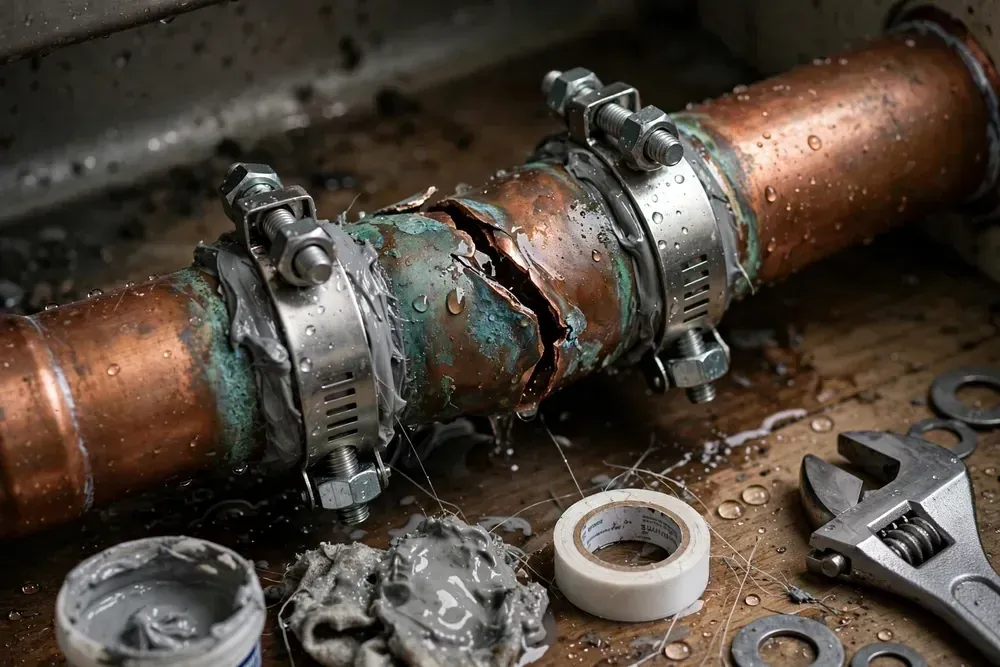
Plumbing tape can help with a leak, but only if you use the right kind for the right place. White thread tape (PTFE) seals the threads of a screwed joint and does nothing for a crack or pinhole in a pipe wall. Self-fusing silicone repair tape can slow a small leak for a short time while you arrange a proper repair.
In Braintree, MA the safe order is the same every time. Shut off the water first, decide whether the leak is at a threaded joint or on the pipe itself, and treat any wrap as a bridge to a real repair, not the repair.
Which tape does what
Most disappointment with plumbing tape comes from using one product for another product's job. This table sorts them.
| Product | Made for | Useful on a leak? | Watch out for. |
|---|---|---|---|
| White PTFE thread tape. | Sealing male pipe threads on water fittings. | Only at a threaded joint that weeps. | Does nothing for a crack and cannot bridge a hole. |
| Yellow PTFE gas tape. | Threads on gas fittings. | Never as a water fix. | Gas work belongs to a licensed professional. |
| Self-fusing silicone tape. | Wrapping and bonding to itself under tension. | Yes, as a short-term wrap on a small leak. | Needs a dry, clean pipe and a tight stretched wrap. |
| Fiberglass resin wrap tape. | Hardening around pipe once activated. | Sometimes, on a pinhole or a hairline crack. | Messy, hard to remove, and fresh resin needs cure time. |
| Epoxy putty stick. | Molding over small holes. | Sometimes, on dry, sound metal. | Not for pressurized flowing leaks and not for joints that move. |
Why thread tape cannot fix a pinhole
Thread tape works by filling the tiny gaps between mating threads so water cannot weave through them. It is thin, it is not adhesive and it has no strength of its own. Wrapped around the outside of a pipe, it only gets soaked and slides off.
If a threaded connection weeps, shut off the water, unscrew the joint, clean the threads and rewrap the male threads in the direction the fitting tightens. Then tighten by hand and about a turn more with a wrench. Over-tightening can crack the fitting, and then you have a bigger leak than the one you started with.
Putting a temporary wrap on a small pipe leak
This applies to a pinhole or a hairline weep on an exposed straight run of copper or plastic. It does not apply to joints under spray or pipes in walls you cannot see.
Shut off and drain.
Close the nearest shutoff, or the main where the line enters the building, then open a low faucet to drain the section. Wrapping a live leak will not hold.
Dry and clean the pipe.
Wipe the area with a rag until it is dry and free of grease and scale. Repair tape bonds poorly to wet or dirty metal.
Stretch and overlap.
Start a few inches before the leak, pull the tape tight and overlap each turn by half. Keep going a few inches past the leak, then press the end down firmly so it fuses.
Restore pressure slowly.
Reopen the valve a little at a time and watch for weeping. If the wrap bulges, drips or sprays, shut the water off again and stop trying to hold it.
Is water spraying right now?
Close the main valve and call (617) 752-0573. We answer around the clock and book same-day appointments when available.
When to put the tape down and shut off the water
Skip the wrap and close the valve if any of these apply. A leak you cannot control is the moment to call, not to keep experimenting.
- Water is spraying or running steadily rather than weeping.
- The leak is near the electrical panel, an outlet or a light fixture.
- The leaking section is a hot water line close to the water heater.
- The pipe is soft, flaking or green with corrosion around the leak.
- You smell gas or the pipe in question carries gas.
A leak at a fitting versus a leak on the pipe body
Where the water appears tells you what to do next.
Weeping at a joint or valve.
- Often a loose nut, dried packing or worn washer.
- Thread tape or a packing nut turn may be enough.
- Soldered joints that drip usually need to be redone by a plumber.
- Valve stems that leak when turned often need the valve replaced.
Weeping or spraying from the pipe wall.
- Points to corrosion, freezing damage or a failed spot.
- Repair tape is a short bridge and nothing more.
- More than one pinhole means the pipe is wearing out.
- The permanent fix is cutting out the section or replacing the line.
How long does a taped repair last?
There is no honest number, because it depends on the pressure, the pipe condition, temperature swings and how well the wrap went on. Treat tape as hours to days, not months. Pipes that flex, vibrate or carry hot water will push a wrap off sooner.
A wrap also hides things. If you cover a pinhole and walk away, you lose the visible warning that the pipe is failing, and water can keep seeping inside a wall. If the same pipe leaks again after a wrap, that is a sign to book a burst pipe repair rather than rewrap it.
Why one pinhole often means more
Pinholes in older copper and corrosion in galvanized steel rarely happen in just one spot. The same water, the same age and the same conditions are acting along the whole run. Census 2020 to 2024 estimates show the median Braintree home was built in 1957, and about 27.5 percent were built in 1939 or earlier, so much of the town has plumbing old enough to need a closer look.
If you have a repeat leak or you cannot see where water is going, a plumber can pressure test the lines and use listening or thermal equipment through leak detection before opening any wall. That is usually less disruptive than guessing.
Know your shutoff before you reach for tape in Braintree
Braintree's Water and Sewer Department regulations say that for a leak inside a building, you shut off the water at the valve where the pipe first enters the building. Find that valve now, while nothing is wrong, and make sure it turns. A stuck main valve turns a small leak into a bigger one, and you want to learn that on a calm day.
The same regulations make the homeowner responsible for keeping the water service pipe working from the curb stop to the house. For a service line leak, the owner gets 10 days to hire a contractor, then a certified-mail notice and a final 10 days before the Town can shut the water off. Tape is no plan for a buried line, so call a plumber and ask the Water and Sewer Department who handles which part.
Plumbing tape questions answered
Only a leak at a threaded joint, because it fills the gaps between threads. It cannot seal a crack or a hole in the pipe wall, and wrapping it on the outside of a pipe does nothing.
For a small pinhole on an exposed pipe, self-fusing silicone tape applied to a dry, clean surface is the usual temporary choice. It is a short bridge until the section can be repaired or replaced.
Do not do gas work yourself. Yellow PTFE tape exists for gas threads, but a gas leak is a safety emergency. Leave the building and call your gas utility's emergency line or 911 first.
Some products tolerate heat and some do not, and hot lines expand and contract enough to loosen a wrap. If the leaking line is hot, shut off the water and call a plumber rather than relying on tape.
No. A leak that returns means the pipe is failing, not that the tape was applied badly. Shut the water off and have the section repaired or replaced.
Braintree's water regulations say an in-building leak is shut off at the valve where the pipe first enters the building. In many homes that is in the basement near the meter. Find it and test it before you have a leak.