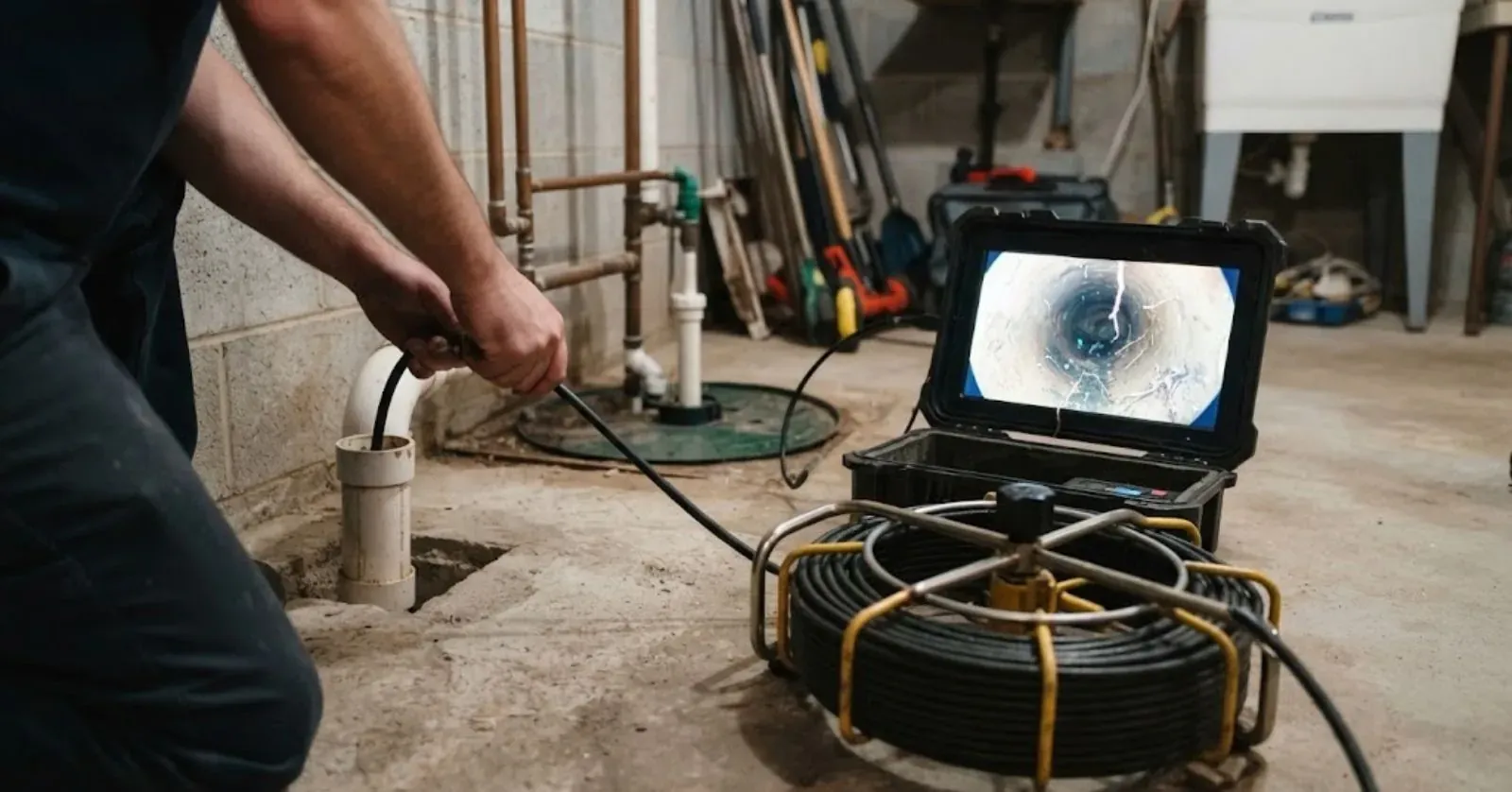
A sewer camera inspection in Braintree, MA is a planned visit in which a waterproof camera on a flexible rod is fed into your lateral so you can watch the inside of the pipe in real time. It answers questions that a cable and a guess cannot: what the pipe is made of, whether roots are entering, and whether it sags or has broken.
Most inspections are booked for a reason that is not an emergency. A house purchase, a string of slow drains, or a repair quote you want to verify are the common ones. If a line is actively backing up, sewer line cleaning comes first and the camera follows.
Before you buy: why the lateral deserves a look
A standard home inspection often does not scope the sewer lateral. It runs underground out of sight, and a failing one can turn a good purchase into a large repair. Braintree's housing leans old: the Census figures show a median build year of 1957 and about 74.7 percent of homes predating 1980.
Pipe in that age bracket is often clay, cast iron or fibre material. A camera look during the inspection period lets you negotiate or walk away with the facts. It is a small cost next to discovering a collapsed lateral after closing.
What the camera can show
The footage turns a vague worry into specific defects with distances attached.
Root intrusion.
Fine roots fanning from a joint, or a thick mass blocking the bore. We note how far in the roots sit.
Cracks and breaks.
Longitudinal or circumferential cracks, missing pieces and holes where soil is entering.
Offsets and bellies.
Joints that have slid apart and low spots holding standing water, a common cause of repeat clogs.
Scale and grease.
Rough buildup on iron and grease coating on any pipe. This shows whether cleaning or jetting would help.
Material and transitions.
Where cast iron meets clay or plastic. Transition points are common weak spots.
Connections.
Where other lines tie in and whether any tie-in is poorly made or leaking.
The inspection from start to finish
Good access keeps the visit short, while a house without a cleanout takes longer.
Find access.
We use the cleanout if there is one. If not, we may pull a toilet or go through a roof vent.
Run the camera.
The camera is pushed through the lateral while a counter tracks distance. We stop at each defect to look closely.
Locate and mark.
A transmitter in the camera head lets a receiver on the surface find the pipe's path and depth, so a defect can be marked on the ground.
Review the footage.
We talk through what we saw, share the footage and give an honest view of what, if anything, needs doing.
Want to see inside the pipe?
Call (617) 752-0573 to book a camera visit. We give you a clear price before work starts.
Matching the finding to the next step
| What the camera found | What it usually means | Typical next step. |
|---|---|---|
| Clean pipe, good slope. | Sound lateral. | Nothing needed. Keep the footage for your records. |
| Grease or light scale. | Pipe works but is coated. | A cleaning, possibly jetting |
| Roots at a joint. | Joint is open. | Cut roots now, then repair or line the joint. |
| Belly holding water. | Section has settled. | Monitor, or repair if it clogs. |
| Collapse or missing section. | Pipe has failed. | Repair or replacement. |
The point of the table is that most findings do not mean replacing the whole line.
Locating the pipe and the property line
A locating run is how we turn camera footage into a spot you can see on the lawn. That matters when a defect lies close to the street and you need to know whether it sits on your side of the line. Town regulations make the owner responsible for the lateral to the property line, with the Town responsible for the section in the public way.
The regulation wording is not perfectly consistent, so we recommend that you confirm the boundary with the Braintree Water and Sewer Department. Our footage and depth marks give you something concrete to bring to that conversation.
Footage, reports and what you take home
You should leave with a copy of the video or a clear way to get it, plus notes naming the distance to each defect. Ask for that before the visit. It helps if you need to show a seller, an insurer or a second contractor.
We give you our reading of the footage, including where we are unsure. A camera shows a lot, but it does not tell you the remaining life of a pipe, and we say so.
Planned camera visit or only a cleaning
Some people skip the camera to save money. Here is how the two paths differ.
Camera inspection first.
- You see the cause, not only the symptom.
- Footage supports negotiation or insurance questions.
- Repair quotes can be compared on facts.
- Locating shows where digging would happen.
Cleaning without a look.
- Quicker when a line is actively backed up.
- Fine for a one time clog in a healthy pipe.
- Leaves defects undiscovered.
- Often repeated when a defect is the cause.
What affects the price of a camera inspection
A camera job is one of the more predictable sewer services, but a few things change the time it takes.
Insurance does not usually pay for an inspection that you order. If a sudden backup caused damage, the footage may support a claim. Call (617) 752-0573 for a clear price before work starts.
Camera inspection questions
The lateral is often outside a standard home inspection, and homes here skew old. A camera look shows whether the pipe is sound before you commit.
It makes the job simpler. Without one we can go through a toilet or a roof vent, which takes more time.
Yes. A transmitter in the camera head lets us mark the pipe's path and depth at the surface.
Ask when you book. We share footage and notes so you can show a seller, an insurer or another contractor.
Confirm the boundary with the Braintree Water and Sewer Department. Town regulations put the public way section with the Town, but the wording is not perfectly aligned.
No. Cleaning opens the line, and inspection reveals its condition. If you need cleaning first, see drain cleaning for fixture lines. For the main line it is sewer line cleaning.
Yes, see our Quincy page for the area we serve from Braintree.