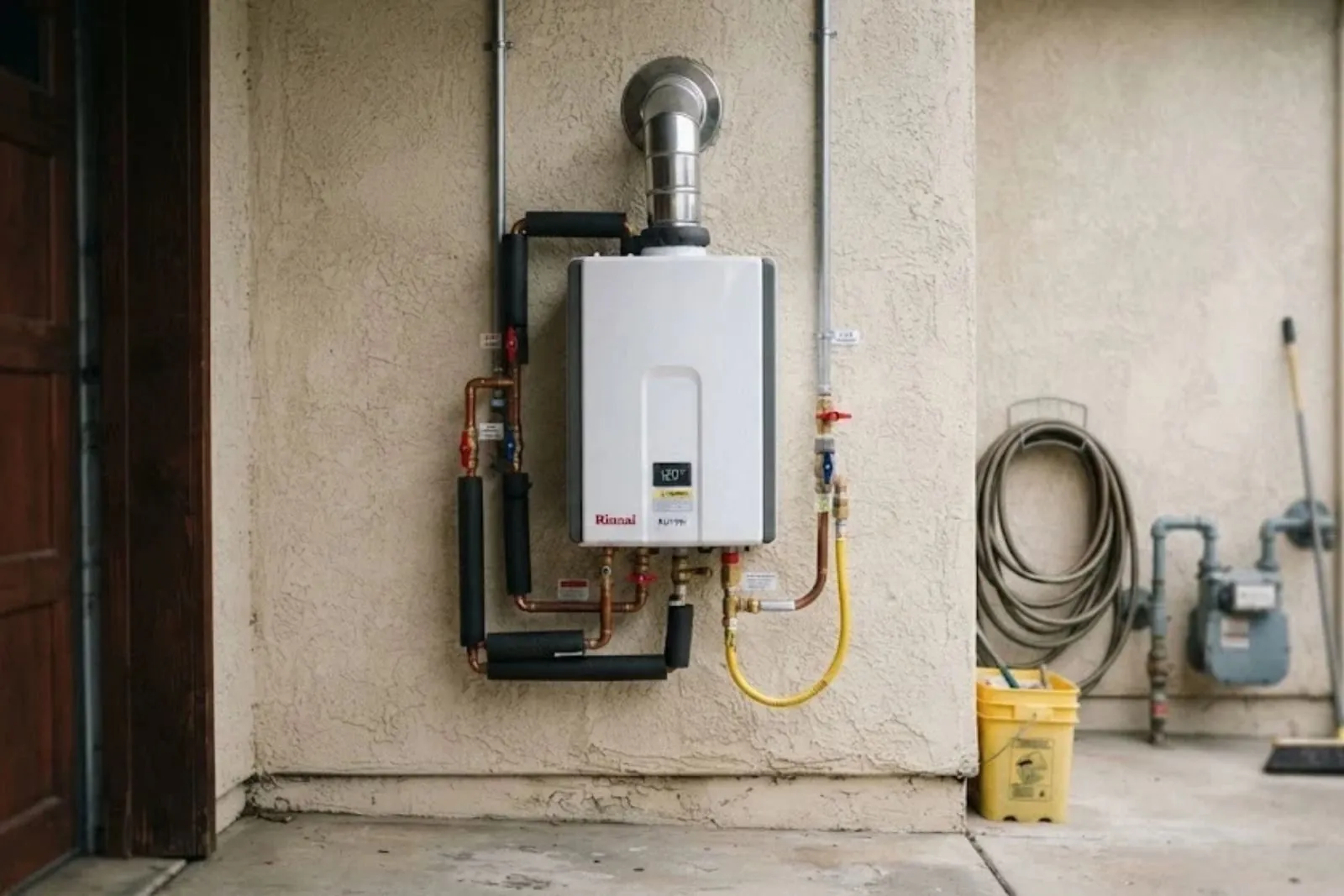
A tankless water heater in Braintree, MA heats water as it flows instead of storing a tank full, using a burner or elements and a heat exchanger that switch on when a tap opens. The payoff is steady hot water and a small footprint. The price is more demanding gas, venting, and maintenance than a tank needs.
This page covers the full life of the unit: installation, repair by error code, the yearly flush and descale that most owners skip, and the recirculation pump that fixes the wait for hot water. If you are still choosing between types, our water heater installation page compares them side by side.
The yearly flush: what it is and why it gets missed
A flush circulates a descaling solution or clean water through the heat exchanger to remove mineral buildup and sediment. It is the single most skipped service on tankless heaters, and it is why many units are blamed for faults that were really a clogged exchanger. Owners often learn this the hard way when a technician says a unit cannot be serviced.
Flush frequency depends on your water. Braintree's own Water and Sewer Department reported hardness of 47.8 mg/L in its 2024 report, about 2.8 grains per gallon by our approximate conversion. That is soft water, so scale builds slowly here, and many households can follow the longer end of the manufacturer's schedule. Your manual and a current copy of the report from your utility should set the interval, not a guess.
Hardness is not the only thing in the exchanger. Fine sediment, debris from older pipes, and the inlet screen filter all collect there. A quick screen cleaning costs nothing and fixes more low flow complaints than people expect.
How we flush and descale a tankless unit
The job needs service valves on the cold and hot lines. Without them, we install a set first.
Isolate the unit.
We shut off the gas and power, close the cold and hot isolation valves, and open the service ports on both sides. The unit is cool before anything is connected.
Connect the pump loop.
A small pump, two hoses, and a bucket of the solution the manufacturer specifies are connected to the service ports. Using a different acid can damage the heat exchanger, so we follow the manual.
Circulate and rinse.
The solution runs through the exchanger for the time the manufacturer lists. We then flush with clean water until it runs clear and clean the inlet screen filter.
Restart and verify.
Valves reopen, the unit is powered and relit, and we check for leaks, flow rate, outlet temperature, and error codes before we leave.
Error code on the display?
Write it down and call (617) 752-0573. We start with the code, the gas supply, and the water flow.
Error code and no hot water: the first checks
Most tankless faults announce themselves with a code on the display. These are the checks that clear the common ones before parts are ordered.
Gas supply.
A closed gas valve, a gas meter that is shut, or a low supply pressure stops ignition. Check that other gas appliances work, but if you smell gas, leave and call your gas utility's emergency line or 911.
Water flow.
Tankless units need a minimum flow to fire. A clogged inlet screen, a half closed valve, or an aerator packed with sediment can hold the flow below that.
Vent blockage.
Exhaust or intake covered by snow, a nest, or a loose coupling triggers a safety shutdown. Look at the outside termination before calling.
Power and controls.
A tripped breaker, a loose connector, or a failed fuse on the board can mimic a fault elsewhere. Reset once, and if it trips again, stop.
Condensate drain.
Condensing models drain acidic water through a trap or neutralizer. A blocked trap can lock out the unit until it is cleared.
Scale in the exchanger.
Rising temperature errors and a loud boil in the unit suggest scale. A flush often restores normal operation, which is why we check it before replacing parts.
Write down the code before you reset anything. The sequence and number tell us which sensor or part to test first.
Installation: what the house has to supply
A tankless install is a bigger project than a tank swap, because the unit asks more of the gas, vent, and water lines.
| Requirement | Why it matters | What we check. |
|---|---|---|
| Gas capacity. | A tankless burner uses far more fuel at once than a tank burner. | Meter capacity, line size, run length, and other gas appliances on the line. |
| Venting. | Most units need sealed plastic or stainless pipe to an outside wall. | Wall location, run length, slope for condensate, and clearances from windows. |
| Water supply. | Low pressure or small piping reduces flow. | Static pressure, pipe size, and shutoff condition. |
| Electric. | The controls, fan, and ignition need power. | An outlet or circuit within reach, and surge protection. |
| Condensate. | Condensing units produce acidic water that must be drained. | A drain or neutralizer within reach. |
| Wall space. | Units are wall mounted and need clearances. | Studs, working room, and access for service. |
The gas meter is the utility's equipment, so a large unit may need the utility to confirm that the meter has capacity. We help you ask the right question.
Recirculation pumps and the wait for hot water
A tankless heater makes hot water quickly, but it cannot shorten the trip down a long pipe. That wait is the pipe full of cooled water, and the heater has nothing to do with it. A recirculation pump moves water through a return line or a bypass valve so hot water is near the fixture.
There are two common setups. A dedicated return line gives the best result and is easiest in new work. A crossover valve under the farthest sink uses the cold line as the return, which is simpler to retrofit but leaves the cold tap slightly warm. A timer or a demand button limits the pump's run, which saves energy and wear.
Not every tankless unit suits a recirculation pump, and some have a built in buffer tank. We check the model and the manufacturer's requirements before adding one, because the wrong pump can trigger cold water sandwich complaints or breach the manufacturer's terms.
Repair or replace when a tankless unit fails
These units can be repaired, but not every fault is worth it.
Often worth repairing.
- A clogged screen, a failed flow sensor, or an igniter.
- Scale that a flush can clear.
- A condensate trap or vent fault.
- A unit that is only a few seasons old.
Often worth replacing.
- A cracked heat exchanger.
- A scaled exchanger that no longer flushes clean.
- Repeated board failures.
- A discontinued model with no parts available.
Converting a tank to tankless in an older home
Census survey data puts the median Braintree home at 1957 construction, so some homes have a gas line sized for a tank heater and a chimney flue shared with a boiler. That can limit a tankless conversion, because the smaller line may starve the new burner and the old flue no longer suits a sealed vent unit. We measure the line and plan the new vent before you buy.
Permits apply to a conversion. Under 248 CMR 3.05, plumbing and gas work may not be installed or replaced until a permit is issued, and permits go only to licensed individuals. Ask the Braintree plumbing inspector about the local steps.
What drives the cost of tankless work
Costs vary far more here than for a tank. Call (617) 752-0573 for a visit and a clear price before work starts.
Tankless failures from scale or neglect are maintenance items and rarely covered. If a unit leaked and damaged finished space, photograph it and talk to your insurer before cleanup.
Tankless questions we hear from Braintree households
Follow your manual, and check the current water quality report from the Braintree Water and Sewer Department. The 2024 report showed soft water, so scale is slower than in hard water areas, but sediment and the inlet screen still need attention.
Common causes are low flow, a blocked vent, a gas supply problem, or scale in the exchanger. Note the code and call. If you smell gas, leave and contact your gas utility or 911 first.
Often, if the model supports it. We check the manufacturer's requirements and choose between a return line and a crossover valve.
Maybe not. The burner draws much more fuel, so the line and meter must have capacity. We measure and confirm before you buy. For the gas side of other projects, see our boiler repair page.
Yes. We start with the error code, the gas supply, and the water flow. If the unit has failed past repair, water heater replacement is the next step, and we also serve Randolph.
Hardness is low in the town's 2024 report, so a softener is not needed for scale. Flushing and a clean inlet screen do the work.