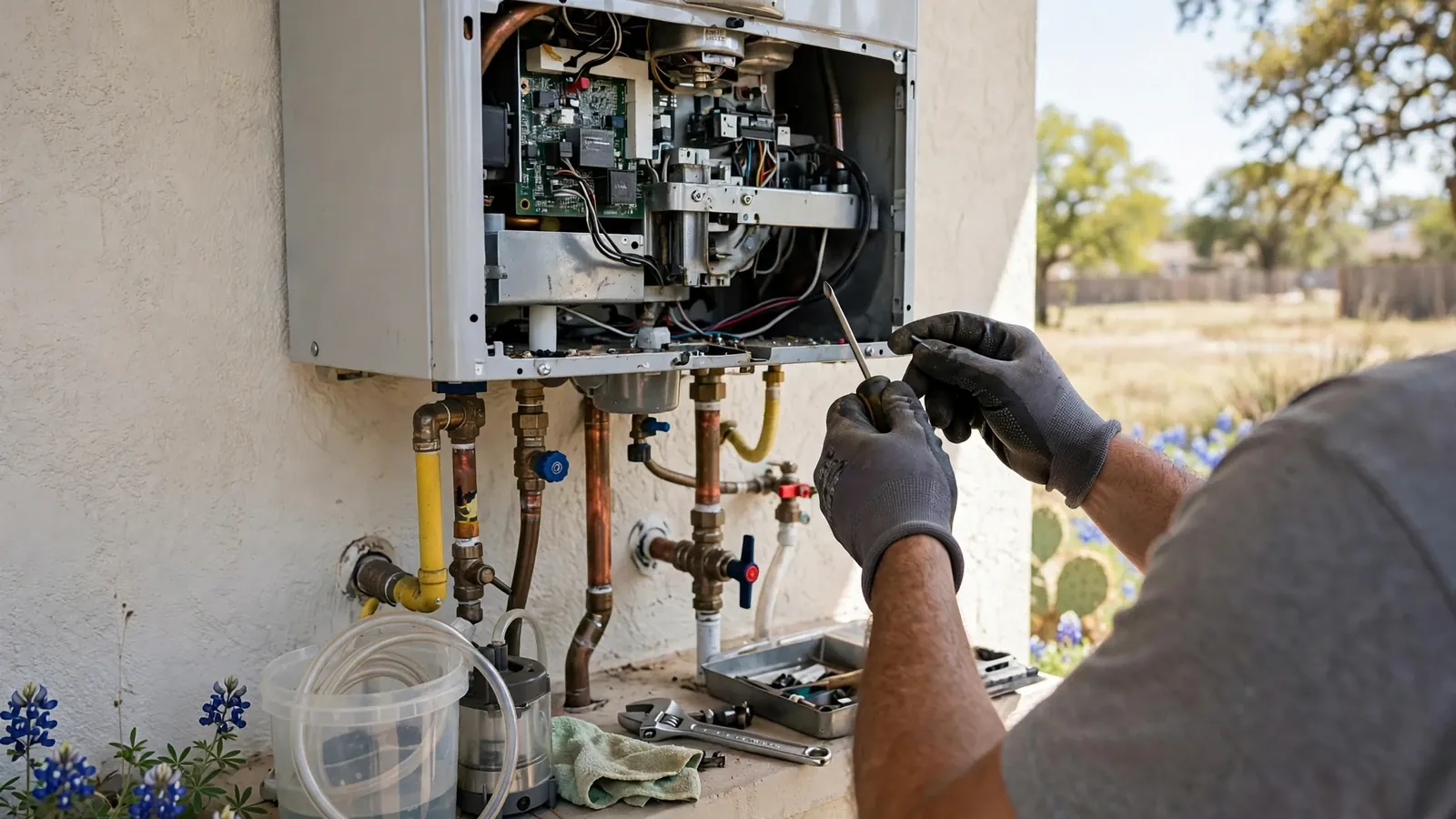
If you smell gas near your tankless water heater, do not stay to investigate. Leave the building now with everyone inside, including pets. From outside, call 911 or your gas utility's emergency line, and call a plumber only after the utility says the home is safe.
That order matters because a gas leak can ignite from a spark you cannot see, such as a light switch or a phone. Below we cover what to avoid touching, what a gas smell near a tankless unit can mean, and what a licensed plumber does after the utility has cleared the house.
Smell gas right now? Do this first
Gas utilities add a rotten egg scent so leaks are noticed. Treat that smell as an emergency even if it is faint or comes and goes. You do not need to find the source before acting.
- Walk outside at once. Take family and pets.
- Do not touch light switches, doorbells, thermostats or appliances. Do not unplug anything, use a lighter or strike a match.
- Do not use a phone inside the house. Call 911 or your gas utility's emergency line from outdoors or from a neighbor's home.
- Do not assume someone else has reported it. Make the call yourself.
- Stay out until the fire department or the utility says it is safe to return.
Why the plumber comes second
The gas utility and the fire department have gas detectors and the authority to shut off the supply at the meter. A plumber cannot match that in the first minutes, and arriving into a gas-filled room puts a tradesperson at risk too. Once the utility confirms the home is safe, the leak source can be found and repaired by a licensed individual.
Do not relight a pilot, reset the heater or flip breakers to see if the smell goes away. If you are unsure whether you smelled gas or something else, the safer call is still the utility. A false alarm costs a few minutes. A missed leak can cost far more.
What the smell can mean near a tankless heater
Not every odor near a tankless unit is a gas leak, but only a trained person with a detector can tell them apart. This table shows what each possibility usually involves.
| What you notice | What it may be | What happens next. |
|---|---|---|
| Rotten egg smell near the heater or gas pipe. | Leak at a union, flex connector, shutoff valve or the heater's own gas train. | Leave, call 911 or the utility, then a licensed plumber. |
| Smell only when the heater fires. | Incomplete combustion, a venting problem or a leak that opens under pressure. | Leave and call, then have the unit shut off and inspected. |
| Burnt or exhaust odor, no rotten egg scent. | Blocked or disconnected vent, dust burning off, or a condensate problem. | Turn the unit off, ventilate, and call a plumber the same day. |
| Carbon monoxide alarm sounds. | Combustion gases entering the home, which have no smell. | Leave and call 911 at once. |
| Smell after the gas company or a plumber worked on lines. | Air or gas in the line, or a fitting not fully tightened. | Leave and call the party that did the work and the utility. |
A carbon monoxide alarm is a separate emergency. If one sounds, leave first and call 911, even if you smell nothing.
Home cleared by the utility?
Once the utility says it is safe, call (617) 752-0573 and tell the dispatcher what the utility found. A licensed plumber can then inspect the heater and its gas line.
Braintree: who is allowed to fix gas piping
State rule 248 CMR 3.05 bars gas fitting work until a permit is issued. Permits go only to properly licensed individuals. That means a handyman or a relative should not patch a gas connection on a tankless unit, however small the fix looks. Ask for the licensed person's permit information before any repair starts.
The same rule has an emergency provision. A licensee may repair before the permit is issued if all required tests are done, the licensee is satisfied the work is safe, and the inspector is notified. The inspection then happens at the earliest opportunity and no later than the next working day. In Braintree the Inspector of Plumbing and Gas sits inside the Building Division at Town Hall, so a same-night repair still ends with the Town being told.
What a licensed plumber checks once the home is cleared
The usual sequence is to shut the gas at the appliance valve, then check every joint from that valve to the heater with a gas detector or an approved leak solution. Common culprits are a union that worked loose, a corroded flexible connector, a failed shutoff valve stem, or a fitting inside the unit. Pressure testing the line confirms the repair holds.
The plumber also looks at the vent, the combustion air, the condensate drain on condensing units and the heater's error history. A tankless unit that keeps tripping on ignition faults can release unburned gas, so the cause is not always a loose pipe. Our tankless water heater page explains the install and service side in more detail.
After the utility says it is safe
These steps assume the utility or fire department has cleared the home and the supply is back on.
Keep the heater off.
Leave the unit powered down and its gas valve closed until a licensed plumber inspects it. Resetting it yourself can repeat the problem.
Describe the smell exactly.
Tell the plumber when you noticed it, whether it came with the heater firing, and whether an alarm sounded. These details narrow the search.
Ask about the permit.
Confirm who will pull the permit and when the Town will be notified. A real repair has paperwork behind it.
Add or test your alarms.
Check that gas-capable and carbon monoxide alarms are working and placed as the manufacturer directs. They are inexpensive backup for the smell test.
When the heater itself may be the problem
Repeated ignition faults, scorch marks around the vent, soot or a heater that was installed without a permit all raise questions beyond a single loose fitting. If the unit is old or has been repaired several times, replacing it may be safer than another patch. The water heater repair page covers how a plumber weighs repair against replacement.
If you live outside Braintree, the same order applies in Randolph, Holbrook or anywhere else. Utility first, plumber second.
Gas smell and tankless heater questions
Call 911 or your gas utility's emergency line first, from outside the building. A plumber should come after the utility has confirmed the home is safe to re-enter.
Yes. A faint or intermittent smell can mean a small leak that worsens, and you cannot judge the size by nose. Leave and call. Calling about a smell that turns out to be harmless is always the right choice.
Not while you are smelling gas. Walk out first. Soap solution is a tool a trained person uses after the utility has cleared the home, together with a detector and a pressure test.
Dust that settled on the burner or heat exchanger over the warm months can burn off and smell like hot dust. That odor is not the rotten egg scent of gas. If you cannot tell the difference, leave and call the utility.
Carbon monoxide has no smell, so you cannot detect it by nose. A working alarm is the only home warning. If one sounds, leave and call 911 immediately.
Only a properly licensed individual can pull the permit for gas fitting work. A same-night repair is allowed if the inspector is notified by the next working day. Ask for the permit details before work starts.