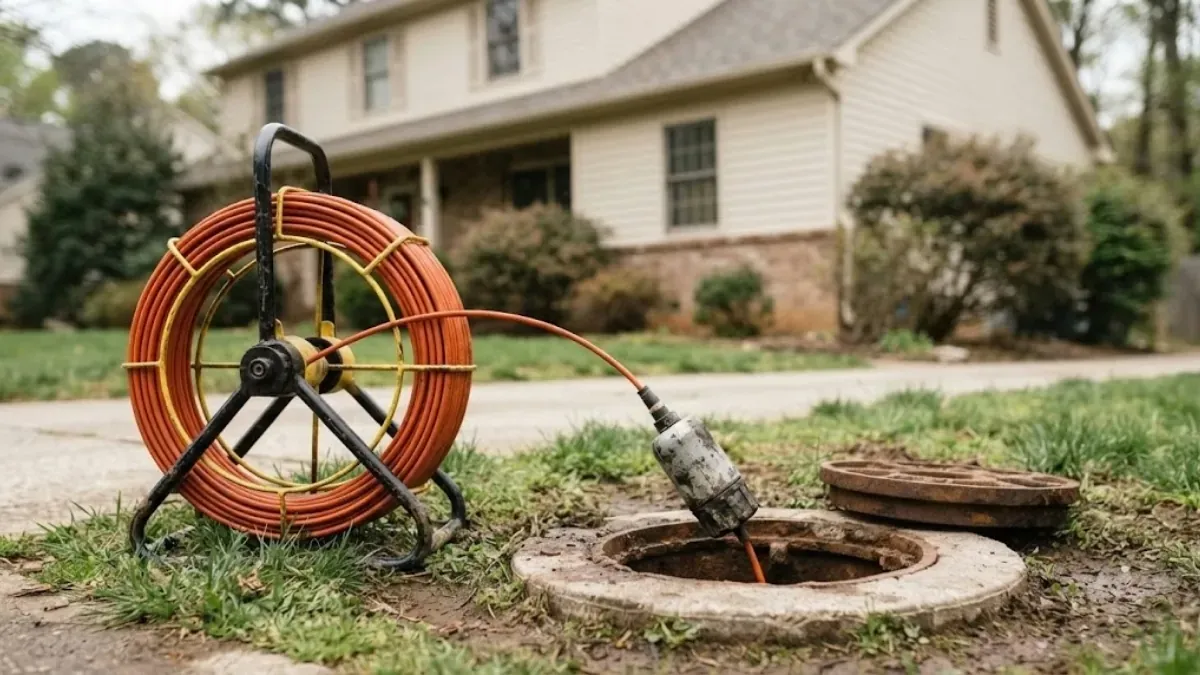
Yes, a sewer scope inspection is worth getting if you are buying an older home in Braintree, MA, if drains have backed up more than once, or if big trees stand near the line. A technician feeds a small camera through a cleanout and watches the pipe on a monitor. It shows cracks, roots, sags and breaks before they become a flooded basement.
It is less useful for a newer house with no symptoms, and it does not replace a cleaning or a repair. The sections below explain what the camera can see, what it cannot, how to read the findings, and who is responsible for the pipe in this town.
What the camera can show you
A good scope gives you a recording and notes at specific distances along the pipe.
Roots.
Fine roots enter at joints and thicken over time. A few hairs may be a cleaning issue. A dense mat that fills the pipe points to repeated backups ahead.
Sags and bellies.
A low spot holds water and waste. The camera shows a pool of standing water, and solids collect there and cause chronic slow drains.
Cracks and offset joints.
Ground movement or age can break a pipe or shift a joint. Soil and water then enter the line, and the damage grows.
Scale in cast iron.
Old cast iron roughens inside as it corrodes, narrowing the opening and catching paper and grease.
Collapse or deformation.
Some mid-century pipe materials soften and flatten. The camera shows an oval or crushed shape well before a complete failure.
Belly or blockage at the street.
If the camera reaches the street connection, it can show whether the problem is on your side or beyond it, which matters for who pays.
The camera does not prove the pipe is leak free, and it cannot see through a full blockage. If the line is jammed, the pipe has to be cleared first.
Reading the result: finding, meaning, next step
A sewer scope is a decision tool. This table links common findings to the usual next step.
| Finding | What it means | Usual next step. |
|---|---|---|
| Clear pipe, smooth walls, good slope. | No visible defects today. | Keep records and rescope if symptoms start. |
| Light roots at joints. | Roots are testing the line. | Cleaning now, rescope in a year or two. |
| Standing water in a low spot. | A sag holds waste. | Watch it, or repair the section if backups occur. |
| Cracked or offset section. | Water and soil entering the line. | Plan a spot repair or a lining. |
| Crushed or collapsed pipe. | The line is failing. | Repair or replacement, often urgent. |
| Camera blocked partway. | Cannot see past the obstruction. | Clear the line, then scope again. |
Once you know the finding, the question becomes whether it needs sewer line cleaning or a full sewer line repair.
Braintree: who owns the pipe and why age matters here
The Braintree Water and Sewer Department's rules make the customer responsible for the service lateral from the property line to the building when the house fronts a public way. The Town takes responsibility where the pipe sits in the public way. Owners on a private way carry more of the line up to the public way. Confirm the exact boundary for your address with the Water and Sewer Department before you assume who pays.
Census data shows about 74.7 percent of Braintree's homes were built before 1980, and the median home dates to 1957. Pipe laid in those decades is where clay, cast iron and older fiber materials turn up, so a scope before purchase or after repeat backups is a sensible check here. Braintree sends its wastewater to the MWRA system, so this is a municipal sewer line and not a septic system.
Backups or a purchase deadline?
Call (617) 752-0573 and tell the dispatcher whether this is a buying timeline or an active backup so the right visit is booked.
Buying a house: how to use the scope in a negotiation
Schedule the scope during the inspection period, before you commit. Ask for the recording and a written summary with distances. A clear scope can support an offer as it stands, and a defect gives you a documented reason to ask for a repair credit or a price discussion.
A home inspector may offer a scope as an add-on. A licensed plumber can do the same and can also say what the repair would involve and whether it needs a permit. Our sewer camera inspection page explains the process and what you receive.
Scope now, or wait?
Two quick lists can help you decide.
Good reasons to scope now.
- You are buying a house built before 1980.
- You have had a backup, gurgling or recurring slow drains.
- Large trees grow near the line.
- You are planning a basement bathroom or major renovation.
- The seller cannot show maintenance records for the line.
Reasons you may wait.
- The house is newer and drains work well.
- A scope was done within the last year or two.
- You are already replacing the whole line.
- The house is being sold as a teardown.
What shapes the price of a scope
We do not list a number here because it depends on your line. These are the factors that move a quote.
Homeowner policies often exclude wear and tear on sewer laterals, though some offer an add-on. Check your policy before assuming coverage.
How a scope visit runs
Find the cleanout.
The tech locates the access point, usually near the main stack in the basement or crawlspace, and protects the floor.
Feed the camera.
A flexible cable with a waterproof camera head is pushed down the line while a monitor shows the live view.
Note every defect.
The tech records the distance at each root, crack, sag or offset joint, which lets a repair crew find it later.
Review the findings.
You get the recording, the notes and a plain explanation of what needs action now and what can wait.
Sewer scope questions from Braintree buyers and owners
Most take under an hour when there is an easy cleanout and a clear line. A blockage, a long run or missing access adds time.
It can show cracks, joints pulling apart and water entering the pipe, but it is not a pressure test. If you suspect a leak in a supply line instead of the sewer, that is a different job.
A careful push camera is gentle and is not used to force through a collapse. If the pipe is fragile, the tech should stop and tell you what they see.
Report it to the Water and Sewer Department. The Town takes responsibility for the part in the public way, but confirm the boundary for your address first.
This guide covers homes on the town sewer. A septic system needs a different inspection and a different company.
Under the Town's rules the owner pays for the lateral from the building to the property line when the house fronts a public way, and the Town handles the part in the public way. Confirm the boundary with the Water and Sewer Department.