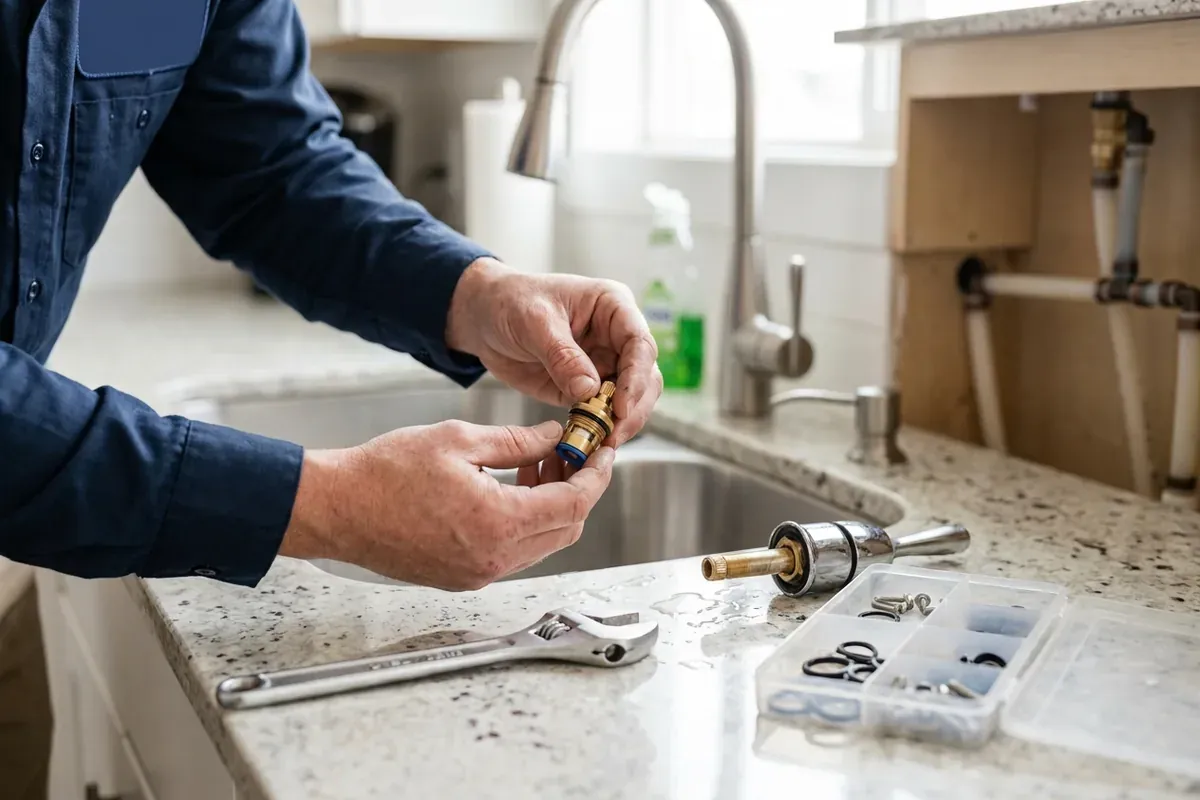
If a faucet, shower valve or supply stop is spraying and will not shut off, close the main valve and call our 24/7 line. Faucet repair in Braintree, MA covers drips, handles that spin, low flow, shower valves, tub spouts, the shutoff valves under sinks and the outdoor spigots that freeze in winter. Night and weekend calls are handled the same way.
Most faucet problems come from a few worn parts, and the repair depends on which faucet you have. Identifying the type of valve inside is what turns a guess into a short fix.
Water spraying and the shutoff will not close
A seized under-sink stop or a broken supply line can empty a lot of water onto the floor. Do not keep turning a valve that is stuck.
- Close the main water valve where the line enters the house.
- Open a lower faucet to drain the pressure.
- Shut off power to the area if water is near outlets.
- Call the 24/7 line and tell the dispatcher which fixture is involved.
Where the drip is coming from tells you what is worn
The location of the leak points to the failed part.
Drip from the spout.
A worn cartridge, washer or seat inside the faucet no longer seals. Water slips past even when the handle is closed.
Water at the base of the handle.
O-rings or packing around the stem or cartridge have dried out. The faucet works but weeps when it runs.
Pool under the sink.
Supply lines, compression nuts or the shutoff valve are leaking. Dry each joint with a tissue to find which one.
Weak or uneven flow.
A clogged aerator or cartridge debris is the usual cause. Soaking the aerator in vinegar and checking the cartridge often fixes it.
Handle spins or sticks.
A stripped handle screw, worn stem or mineral buildup. Hard handles often mean the cartridge is wearing out.
Sprayer or hose problems.
Pull-out sprayers leak at the hose connection or the diverter. The fix is usually a new hose or diverter.
If the sink area is wet and the faucet is not the source, the leak may be in the drain or supply piping. See leak detection if it keeps coming back.
Faucet valve types and how each is repaired
Knowing the type inside saves time and parts.
| Faucet type | How to tell | Common failure | Repair approach. |
|---|---|---|---|
| Compression (two handles) | Handle turns many times to close. | Washer and seat wear. | Replace washer and sometimes the seat. |
| Cartridge. | Single or double handle with smooth motion. | Seals and cartridge wear. | Swap the cartridge. |
| Ball. | Single handle over a rounded cap. | Springs, seals and the ball itself. | Rebuild kit. |
| Ceramic disc. | Single handle with smooth, quiet action. | Cracked disc or seals. | Replace the disc cartridge. |
| Pressure-balancing shower valve. | Shower handle with a temperature stop. | Worn cartridge or seals. | Replace the cartridge from the front if the valve is accessible. |
Old faucets sometimes use parts that are no longer made. If a replacement cartridge is not available, a new faucet is often the better answer than hunting for a part.
Faucet or valve leaking badly? Call now.
Shut off the main valve and call the 24/7 line. Tell us which fixture is involved and what it is doing.
Shower valves and bathtub faucets
Showers and tubs share a valve inside the wall. A leaking showerhead after the handle is off means the cartridge has failed. A tub spout that dribbles when the shower is on has a worn diverter. Water that changes temperature when someone flushes a toilet suggests a pressure balancing cartridge that needs replacing.
Access matters. Some valves can be reached by removing the handle and trim plate, while others need an opening in the wall behind the tub. A plumber will tell you which before work starts, and tile or access panels can change the scope.
A bathtub faucet that will not shut off at all deserves a quick call. A running tub faucet wastes water and can overflow.
How a faucet repair goes
A good repair is mostly identification and fit.
Shut the water and open the faucet.
The plumber closes the stop valve under the sink or the main valve and opens the faucet to release pressure, then plugs the drain so no small parts are lost.
Identify the valve type.
Brand, handle style and the valve inside decide which cartridge, seal or stem is needed.
Replace worn parts.
Cartridges, O-rings, seats and washers are replaced as a set. Mineral deposits are cleaned from the body so the new parts seal.
Test and explain.
Hot and cold, handle travel, flow and every joint are checked. You get a plain explanation of what failed and what to watch.
Supply lines, stop valves and burst connectors
The small pieces under the sink fail more often than the faucet. Braided supply lines can corrode or burst, and old stop valves seize or drip from the stem. A burst or broken supply valve is a classic emergency, because the line is under full pressure.
The fix is to replace the line or the valve. Quarter-turn stops are easier to use than the old multi-turn kind and are worth installing when a plumber is already working there. Replace supply lines on a schedule, not just when they fail, if they are old and braided.
If you can't close a shutoff, don't wait. Close the main valve, then call.
Hose bibs and outdoor spigots in a New England winter
A frozen outdoor spigot is one of the most common winter failures. The Blue Hill area, which is the nearest weather station read, averages about 121 days a year at or below freezing. Braintree is lower and nearer the coast, but the pattern is the same. Water left in the spigot or the pipe behind it can freeze, expand and split the pipe inside the wall, where you cannot see it.
Disconnect hoses before the first hard freeze and close the interior shutoff to the spigot if there is one. Frost-free hose bibs are built with a long stem that puts the seat inside the warm wall, but they only work if the hose is off and the spigot slopes slightly down. The Town's cross-connection flyer advises vacuum breakers on hose bibbs, so ask about one when a new spigot goes in.
If you find a spigot that drips inside the house after a thaw, shut the interior valve and call. That is a burst pipe in progress. Our burst pipe repair page explains what happens next.
What affects the cost of faucet work
A cartridge swap and a shower valve rebuild are different jobs. The factors are below.
A sudden burst valve that floods a kitchen or bath may be covered, while a slow drip that rotted a cabinet may not. Document the damage and ask your insurer. Call for the real number.
New faucets, garbage disposals and other fixtures
If you want to change faucets, the swap is usually simple when the sink holes match. Kitchen sinks with a disposal share the drain area, so see garbage disposal repair when the leak is under the sink basin. For larger fixture work, plumbing installation covers new fixtures and layout changes.
We also serve Randolph and nearby towns with the same 24/7 line.
Faucet and valve questions
Yes. The 24/7 line is answered around the clock, so a spraying faucet, a burst supply line or a valve that will not close at night or on a weekend gets a plan. Close the main valve first. Same-day appointments are offered when the schedule allows.
The cartridge, washer or seat is worn, so water slips past the seal. Replacing the part usually stops it.
Repair when one part has failed and replacements are available. Replace when the faucet is old, corroded or multiple parts are failing.
Old stops seize from mineral buildup and age. Do not force one. Close the main valve and call, because a broken stop can flood the room.
Disconnect the hose before freezing weather, close the interior shutoff if there is one and consider a frost-free spigot. If it drips inside after a thaw, shut the interior valve and call.
Often yes, if the cartridge can be reached from the front. Some valves need an access opening. The plumber will say which before work starts.
A worn pressure balancing or mixing cartridge is the usual cause. If the temperature jumps when a toilet flushes, replacing the cartridge often fixes it.