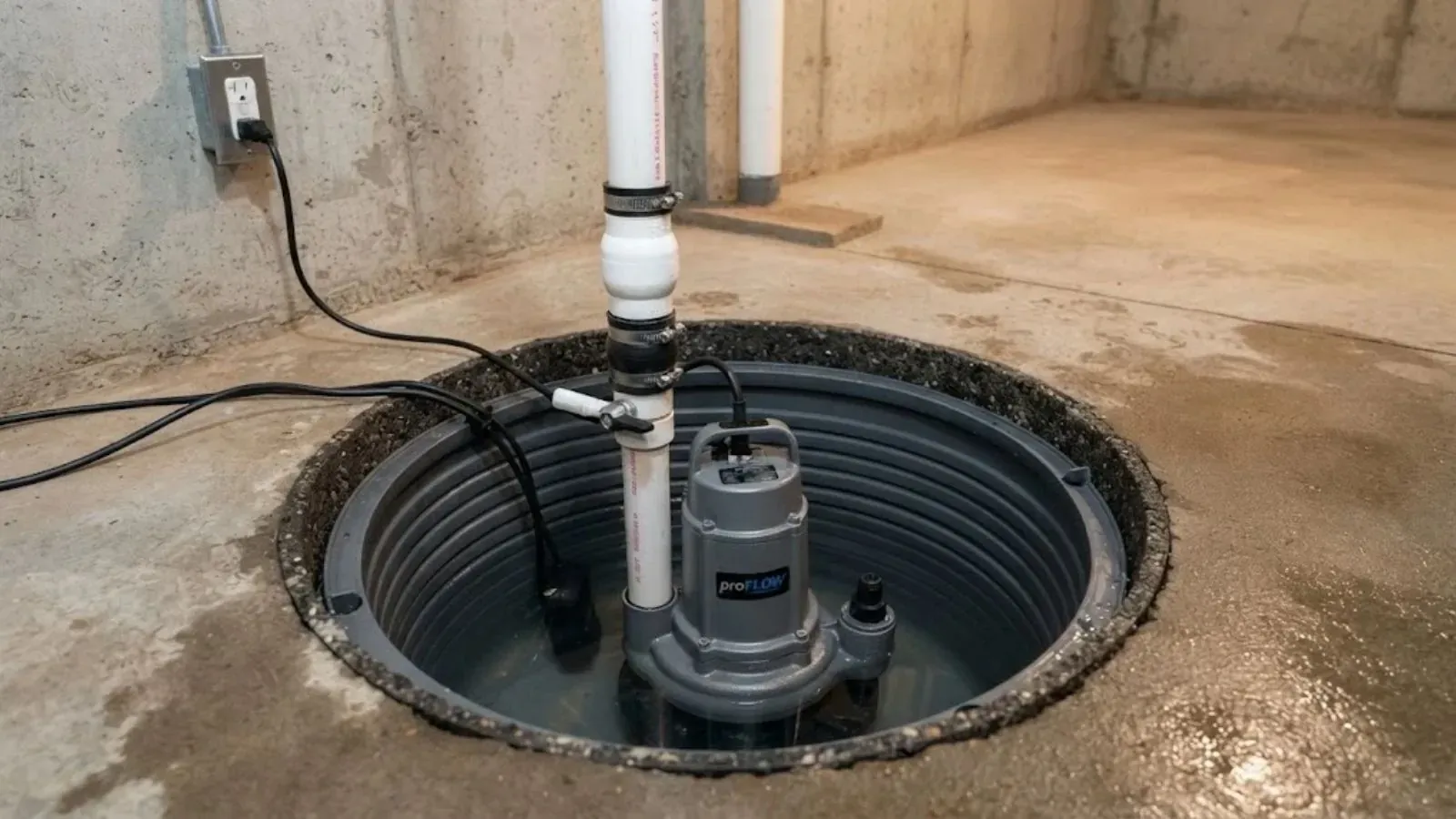
If your sump pit is filling and the pump is silent, call our 24/7 line now and start bailing or wet-vacuuming the pit while you wait. Check that the pump is plugged in and the breaker or GFCI outlet has not tripped, because that is the quickest fix on a storm night.
Sump pump installation and repair in Braintree, MA covers the pump that clears groundwater from beneath your basement floor, its float switch and check valve, the discharge line outside, and the battery backup that keeps it running when power fails. The sections below explain what fails, how it gets fixed, and where the water has to go.
The pit is full and the pump will not run
Unplug the pump before you reach into the pit, then plug it directly into a different outlet to rule out a dead GFCI. Lift the float by hand. If the pump starts, the float switch is stuck or tangled, and if it hums without moving water, the impeller may be jammed or the check valve stuck shut.
Keep electronics and stored items off the floor and shut off power to any outlet near standing water. Never wade into water that could touch a live circuit.
- Run a wet vacuum or bucket to hold the pit level while help comes.
- Do not pour pit water down a floor drain connected to the sewer.
- Open the outdoor discharge end to see whether it is frozen or blocked.
- Note whether the power is out, which changes the plan.
Where the pump is allowed to discharge in Braintree
The Braintree Water and Sewer Department's rules prohibit discharging sump pumps, roof drains, and foundation drains into the sanitary sewer. The regulations list cellar sump pump discharge and cellar floor drainage among the prohibited connections. That settles where the discharge line goes: outside, to a place that carries water away from your foundation and onto a surface that can absorb or shed it.
The rules also treat allowing inflow and infiltration as a violation. If it is suspected, the owner notifies the department, and once confirmed the owner gets ten days to hire a contractor, followed by a notice and a final ten days before a daily fine may be levied. A pump piped into a floor drain or a sewer cleanout therefore needs to be redirected promptly. Ask the department if you are unsure how your system is connected.
A good outdoor discharge also avoids creating a new problem. Pointing the pipe at a neighbor's wall, a walkway that ices over, or right back at your own foundation just recycles the water. A buried line needs a slope and a freeze plan, and the end should have a screened outlet.
Pump quiet and the pit rising?
Call (617) 752-0573. We answer overnight and book same-day visits when available.
Why sump pumps fail, and the fix for each
Most failures are small parts and not the whole pump, which is why a diagnosis comes before a replacement.
| Failure | Typical cause | Usual fix. |
|---|---|---|
| Pump will not start. | Tripped GFCI, stuck float, failed switch, or dead motor. | Reset, free or replace the float, replace the pump if the motor is gone. |
| Runs but moves no water. | Air lock, jammed impeller, or a stuck check valve. | Clear the impeller, drill a relief hole, replace the check valve. |
| Runs constantly. | Float stuck on, check valve leaking back, or very high groundwater. | Reposition the float, replace the check valve, test the discharge. |
| Short cycles on and off. | Pit too small, check valve failing, or a float set too tight. | Adjust or replace the float, enlarge the pit, replace the valve. |
| Loud rattling or banging. | Worn bearings or a loose check valve. | Replace the pump or valve. |
| Dies during an outage. | No backup power. | Add a battery backup or water powered unit. |
A pump older than its warranty that has started to short cycle is a good candidate for replacement, even if it still moves water.
Submersible or pedestal: choosing the pump
Both clear a pit. They differ in noise, space, and how well they handle debris.
Submersible pumps.
- Sit underwater in the pit and run quietly.
- Cool themselves in the water and handle heavy loads.
- Harder to reach when they need service.
- Better for finished basements and larger pits.
Pedestal pumps.
- Motor sits above the pit and is easy to service.
- Louder and more exposed to damage.
- Narrow pits and tight spaces suit them.
- Usually shorter lived than a good submersible.
Backup power, float switches, and check valves
Pumps rarely fail alone. The parts around them often decide whether your basement stays dry.
Battery backup.
A second pump on a deep cycle battery keeps the pit clear when the power fails, and storms often take power with them. It needs a charger and a battery replaced on the maker's schedule.
Float switch.
A tethered float can snag on the pit wall or its own cord. A vertical float or electronic switch avoids this. We test the full on and off cycle before we leave.
Check valve.
A check valve stops water in the discharge pipe from falling back into the pit each cycle. A failing one makes the pump short cycle and wears it out.
Alarm.
A high water alarm gives you minutes of warning when the pump is overwhelmed or off. It is cheap insurance for a finished basement.
Storms, river flooding, and why a backup is worth discussing
In March 2010, more than nine inches of rain fell over a few days and the Monatiquot and Farm Rivers overflowed their banks, according to the Town of Braintree. That event was river flooding, which no sump pump can stop. It still shows how fast conditions can change, and a heavy storm that raises the groundwater around your foundation is exactly when a pump works hardest.
The Blue Hill weather station in Milton records about 54 inches of precipitation in an average year. For a Braintree homeowner, that annual total means the pump will run often, and a battery backup and an alarm are worth discussing for any basement with finished space.
Installing a new sump pump system
For a basement with no pit, or a pit with a worn pump, a full install follows this order.
Locate the water.
We look for where water enters, set the pit at the lowest point, and decide whether a perimeter drain should feed it.
Set the pit and pump.
A proper liner goes into the slab opening, with gravel at the bottom. The pump sits level on a base so it does not suck debris.
Pipe the discharge.
We install a check valve, run sealed pipe outside, and finish the end with a screened outlet. The line never connects to the sanitary sewer.
Test and add backup.
We fill the pit, run several cycles, and confirm the alarm and backup both work. Ask the plumbing inspector whether your job needs a permit.
A note on sewage ejector pumps
A sump pump handles clear groundwater. A sewage ejector pump is different, because it lifts wastewater from a basement bathroom or laundry up to the main sewer line. It uses a sealed pit with a vent and a solids handling pump, and it should never be treated as a sump.
If your basement bath backs up, call us and describe the equipment. Our sewer line repair page covers the related problems.
What decides the cost of sump pump work
A float swap and a full system with backup are different jobs. Call (617) 752-0573 and we give a clear price before work starts.
Many homeowner policies exclude groundwater and rising water, and treat sump pump overflow as a separate coverage. Ask your insurer what yours says before a storm, and photograph damage before cleanup.
Sump pump questions before the next storm
Yes. The dispatch line takes calls overnight and on weekends, and we book same-day visits when available. Check the plug and GFCI, lift the float, and hold the pit level with a wet vacuum until we arrive.
No. The Water and Sewer Department's rules prohibit sump pump, roof drain, and foundation drain discharge into the sanitary sewer. The discharge goes outside, away from the foundation.
It depends on pit size, the pump rating, and how long outages last. A battery backup buys hours, not days. We size it to your pit and discuss a generator or a water powered unit if outages run long.
No. Water from a supply leak, a sewer backup, or a cracked wall is a different problem. See our basement waterproofing page for the sources a pump cannot fix.
Plumbing work generally needs a permit under 248 CMR 3.05, and permits go to licensed individuals. Ask the Braintree plumbing inspector whether your pump work falls under it.
Yes. We serve Weymouth and surrounding areas from Braintree. If your basement also has a leak, our leak detection service can help.